
Saving A Sexless Marriage The Right Way
Understanding why intimacy fades — and how couples can reconnect.
Intimacy in long-term relationships rarely disappears all at once.
More often, it fades gradually — through small changes in communication, emotional connection, daily habits, and unspoken distance that builds over time.
What many couples experience is not the loss of love, but the quiet development of patterns that slowly reshape how they relate to each other.
Understanding those patterns is where meaningful change begins.
Not Sure Where to Start?
Most couples arrive here with one of three questions:
- What changed in our relationship?
- Why has desire or attraction shifted?
- How do we reconnect and rebuild intimacy?
You can begin with whichever feels closest to your situation.
Choose Your Starting Point
Understand What’s Happening
Explore the patterns that develop in long-term relationships — including communication breakdown, emotional withdrawal, and gradual disconnection.
Explore Relationship Psychology & Patterns
Understand Desire & Attraction
Learn why desire changes in long-term relationships, what affects attraction, and how emotional and physical intimacy are connected.
Explore Sex, Desire & Attraction
Rebuild Connection
Practical, realistic steps to help couples restore emotional and physical closeness over time.
This is more common than many people realise.

For many people the first point of contact is finding out exactly what a sexless marriage is, particularly in cases where the sexual relationship has been slowly fading away over time.
If you are here then I imagine you have noticed some of the differences in your relationship already:
* Have the conversations now become shorter and more functional than they were?
* Have those physical expressions and little touches disappeared – or have they long since disappeared?
* Have you started to feel that something about your marriage is not quite the same as it once was… You just don’t know when it started?
Unless this is the first website you’ve seen, you already have an idea of what a sexless marriage is. You may have also already seen stats, scanned articles and been pointed from one web page or explanation of the situation to another and felt like none of them describe the real issues in your marriage.
Stats can be useful when viewed in the context of what’s actually happening in your marriage and are helpful only in as far as you understand what they can and do tell us about our relationships.
Across countries national surveys repeatedly show that quite a large percentage of long term married couples admit to times where they have no sexual intimacy at all and it appears to be more common than you might imagine.
So if this is the case in your relationship, you are not on your own; however, statistics alone do not explain the reasons for change or what to do about it.
You Are Not Alone, And You’re Not The First!
It’s very common for partners in long-term relationships to experience stages when neither knows what is going on between them.
Often, this happens very subtly. Life gets more complicated. Life gets more stressful. The brief times you spend together, talking, start dwindling, and something changes, not obviously, for either one of you or the other, but something definitely changes.
The important thing to know here is that growing apart, or finding yourself struggling with intimacy, does not mean your marriage is over.
More often than not, it simply means that communication patterns have begun to malfunction under changing pressures, and as those patterns become visible to the two of you, those patterns begin to change again.
This web site is for partners who are still intimately connected, who still deeply love each other, but just somehow lost the plot. What people find happens often isn’t that the love is gone, it’s just that some small communication glitch happens, builds quietly up over time, and continues there, unrecognized for what it is.
Another thing that people often wonder is whether a sexless marriage is normal, especially under stress, for long-term married partners.
How to Fix a Sexless Marriage Without Blame or Pressure
How to Use This Site
This site is designed to help you understand what may be happening in your relationship before trying to change it.
- Start with understanding
- Explore what feels relevant
- Move toward rebuilding
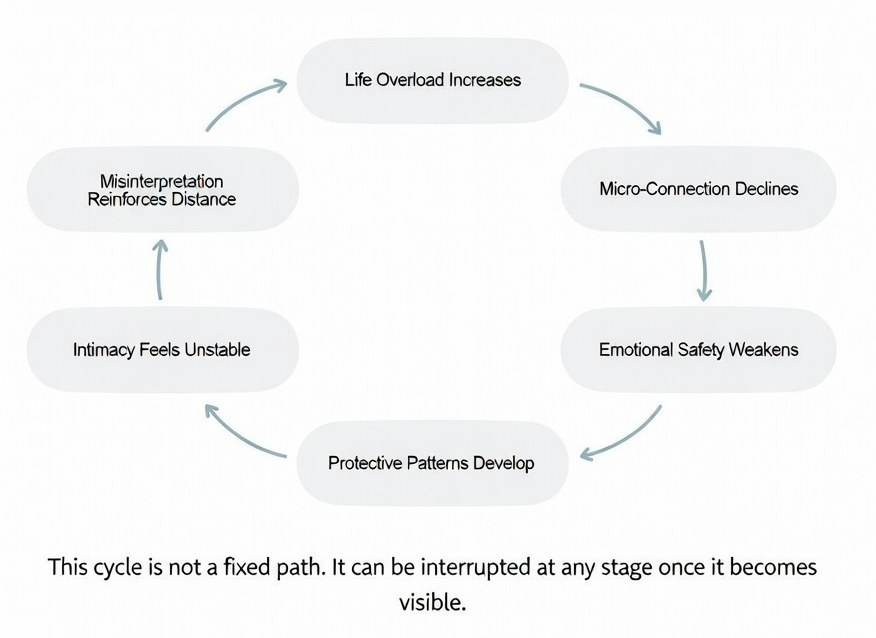
To understand why this happens, it helps to look at the pattern beneath it.
Understanding the Communication Breakdown Loop:
Many couples gradually move through predictable shifts before intimacy begins to feel unstable.
These shifts rarely appear all at once. They tend to develop quietly through everyday pressures, subtle communication changes, and protective reactions which slowly reshape the emotional climate of the relationship.
We refer to this pattern as the Communication Breakdown Loop.
What This Means For Your Relationship
A lot of couples discover that the distance they’re feeling did not appear suddenly, it developed gradually through small shifts in communication, attention, and emotional safety.
Once those patterns become visible, they can begin to change things.
The reason behind this framework is simply to make those patterns easier to recognise.
Explore Each Stage of the Communication Breakdown Loop
You may recognise one stage immediately.
You may recognise several.
Many couples move through parts of the loop gradually without noticing the shift until distance has already begun to form.
Each stage below explains one part of the pattern and how it affects connection inside a long-term relationship.
You can begin anywhere.
Life Overload and Intimacy
How stress quietly changes connection inside a relationship.
Why Micro-Connection Matters More Than You Think
The small gestures that quietly sustain emotional closeness.
Understanding Emotional Safety in Marriage
How uncertainty and hesitation begin to shape communication.
Protective Patterns in Relationships
Why partners sometimes withdraw or guard themselves.
When Intimacy Feels Unstable
How emotional distance begins to affect physical closeness.
How Misinterpretation Reinforces Distance
The assumptions and misunderstandings that quietly deepen separation.
This cycle is not a fixed path. It can be interrupted at any stage once it becomes visible.
Understanding the pattern reduces fear. Adjusting the pattern restores connection.
Understanding why marriages become sexless often reveals that the problem develops through small communication changes over time.
A Structured Path Forward
For many couples, understanding the pattern is enough to begin making meaningful changes.
For others, it helps to follow a more structured approach.
Restoring Intimacy in Your Marriage brings these ideas together into a step-by-step framework, helping couples understand what changed — and how to begin reconnecting in a practical, realistic way.
Explore the full relationship framework
Common Questions About Sexless Marriages
What is considered a sexless marriage?
A sexless marriage is typically defined as a relationship where sexual intimacy occurs very rarely or stops altogether over a long period of time.
How common are sexless marriages?
Studies suggest that a significant number of long-term couples experience extended periods with little or no sexual intimacy.
Can a sexless marriage recover?
In many cases, intimacy can return once couples understand the emotional and communication patterns that created distance.
Understanding Sexless Marriages
Many couples searching for answers about intimacy changes are trying to understand what is happening in their relationship.
These articles explore the most common questions about sexless marriages, including why they happen, how common they are, and how couples can begin rebuilding connection.
For a complete overview of this topic, visit our guide to understanding sexless marriages.
What Is Considered a Sexless Marriage?
Why Do Marriages Become Sexless?
Is a Sexless Marriage Normal?
Signs a Marriage Is Becoming Sexless
How Common Are Sexless Marriages?
Sexless Marriage Statistics
Sexless Marriage Effects
Can a Sexless Marriage Survive?
How to Rebuild Intimacy in a Sexless Marriage
Restoring Intimacy
For couples who remain committed to one another—but recognise that something has quietly changed.
Intimacy rarely disappears without a pattern forming beneath it. In most long-term relationships, distance develops gradually through small, repeatable shifts in communication, expectation, and emotional responsiveness.
When those patterns are not clearly understood, they can feel random, personal, or irreversible.
They are not.
A Structured Approach to Reconnection
This site presents a framework developed through sustained study of relationship dynamics, attachment patterns, and long-term partnership behaviour.
Rather than offering quick fixes or emotionally driven advice, the focus is on:
- Identifying the underlying patterns that reduce intimacy
- Understanding how those patterns develop over time
- Providing practical ways to interrupt and change them
The aim is clarity—not persuasion.
Because when a pattern becomes visible, it becomes manageable.
A Different Kind of Guidance
Much of the advice in this space is either:
- Overly simplified
- Or unnecessarily alarm-driven
This work takes a different position.
It reflects how disconnection typically occurs in stable, long-term relationships—without crisis, without a defining moment, and often without either partner fully understanding why.
About the Author
C.J. Taylor combines lived experience with ongoing, focused study of relationship behaviour and communication breakdown patterns across long-term couples.
The approach presented here is shaped by recurring themes observed across real relationships, and aligned with established principles from relationship psychology and attachment theory.
This is not about assigning blame.
It is about understanding what changed—so that connection can be rebuilt with intention.